
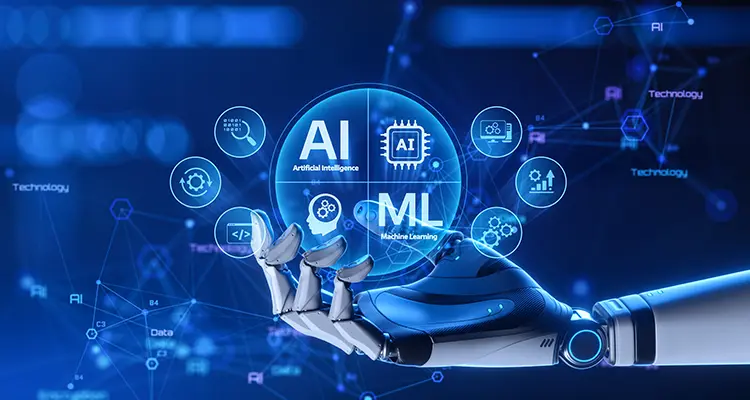
AI and ML for Enterprise Transformation
AI and ML are changing the way business is conducted, innovated and competitive in the digital economy. The technologies can help organizations to become more efficient, reduce costs of doing business and make smarter business decisions by analyzing vast volumes of data and automating complex business processes in different departments and industries worldwide.
The current business depends on AI and ML to identify knowledge based on structured and unstructured data. Such technologies allow organizations to identify trends, foresee outcomes and automate the operations. Consequently, businesses have the ability to react more quickly to the market variations and enhance the customer experience and business performance.
AI and ML platforms are being put into heavy investments by technology giants like Microsoft and Google. Their cloud services assist businesses in consolidating advanced analytics, automation devices, and smart systems to propel large-scale strategic digital transformation plans.
Understanding AI and ML in Enterprises
Artificial intelligence is a term used to refer to machines that can execute things that need human intelligence whereas machine learning engages in learning algorithms based on information. AI and ML combined provide a company with the ability to handle information, discern trends and forecast with great precision.
Business organizations use AIs and ML systems to automate their routine operations, analyze the business data, and aid decision-making. The technologies assist companies in changing the traditional operations into smart data-driven processes that enhance productivity and efficiency.
As the amount of digital data increases, AI and ML are now crucial to the contemporary organization. By using these technologies, enterprises can have a better understanding of customers, operations, and trends in the market, which can be used to plan strategically and have a competitive edge.
AI and ML for Business Automation
Artificial intelligence (AI) and machine learning (ML) are driving automation that transforms the work of enterprises. Repetitive and time-intensive processes, which include document processing, data entry, invoice management, and workflow coordination, can be managed by intelligent systems with the involvement of the minimum number of people. This automation lowers the mistakes, accelerates the work, and uniforms the outcomes in different departments.
Automation also facilitates businesses to scale, and it is achieved through AI. Big piles of work, such as customer support tickets, inventory, and others can be done at the same time without any delays. This liberates employees to work on strategic plans, including creating new products, customer experience, or business process optimization, where human creativity and critical thinking are needed.
In industries, AI and ML automation systems are changing such major functions as supply chain management, financial reporting, marketing campaign execution, and HR operations. Intelligent automation adoption will introduce more productivity to enterprises, reduce the cost of operations as well as make sure that they are at the forefront in the dynamic and demanding business environments.
Data-Driven Decision Making
Using AI and ML, companies will be able to make better, faster, and more accurate decisions by analyzing the vast volumes of data available to them. It can identify the patterns, trends, and correlations that are highly difficult to determine using traditional methods with the aid of sophisticated algorithms. This ability allows companies to gain useful, practical insights about the operations, marketing, finances and customer experience.
Organizations use the AI and ML to forecast demand, predict market trends, optimize inventory, and understand customer behavior. Monitoring the performance of operations in real-time, the enterprises can detect inefficiencies, make changes to strategies, and take the opportunities as they arise. The foretelling analytics are also useful in risk reduction by making predictions supported by data to invest, expand, and launch products.
Decision-making is more precise with the use of evidence-based decision-making, which reduces the level of uncertainty and competitive advantage. With such wisdom of AI, businesses will be able to conduct their operations with some degree of confidence, respond swiftly to market dynamics and take advantage of long-term growth. This is essentially a change in how decision-making is carried out to become more proactive than reactive, which makes the enterprises more responsive, efficient, and strategically aware in the current high-paced digital economy.
Enhancing Customer Experience
AI and ML technologies are also being employed by businesses to enhance the customer experience on the digital platform. Intelligent systems analyze the habits and preferences of the users and their past experiences in order to provide them with individual offers, discounts, and interesting information, so that clients can feel valued and listened to. Such personalization based on data assists companies in establishing more robust connections, and creating more engagement.
Virtual assistants and chatbots, which are driven by AI, are important to offer 24/7 customer support immediately. These systems are also capable of giving answers to frequently asked questions, giving instructions on products or services, as well as troubleshooting problems on its own. Scanning through large numbers of customer interactions can be effectively managed by automating repetitive queries and, in the process, ensuring the same level of service and lowering the time of reply.
Additionally, AI and ML analytics can enable businesses to know what customers want and be able to predict their preferences. Firms are able to create products, services and marketing efforts that are innovative to a certain audience group, enhance user satisfaction and brand loyalty. Finally, AI-based intelligent customer experience strategies are effective in engaging and developing business in the long term.
Challenges in Enterprise AI Adoption
Despite the apparent advantages of AI and ML, there are several problems that companies face when implementing the technologies. One of the biggest challenges is represented by high-quality and well-structured data. Machine learning algorithms have to be based on precise, varied, and comprehensive datasets to provide solid results. The quality of data might be poor, and this fact may cause wrong forecasts and diminish the efficiency of the AI-based decision-making.
Implementing AI systems with the current enterprise infrastructure also has challenges. Companies need to be compatible with old software, scale, and modify workflows in order to deal with intelligent automation. The implementation of AI can ruin operations instead of making the operations better without proper planning.
Ethics are also of great concern. Companies must ensure they address privacy of the data, transparency and bias of the algorithm so as to stay trusted by the customers and stakeholders. A sustainable path towards AI governance would mean that AI and ML systems are utilized in a just, safe and controlled way that upholds the integrity of the businesses and encourages sustainability in adopting them in the long term.
Future of AI and ML in Enterprises
The future of AI and ML in changing enterprises is very bright. The intelligent systems will also be more advanced with the advance of technology and will enable another level of automated systems and more accurate predictions.
Businesses will be able to create smarter applications with the introduction of the new technologies such as generative AI and more complex neural networks. The systems will enhance decision-making process, ease operations and create new business opportunities.
AI and ML will remain in the future of digital enterprises. Those organizations that are strategic in adopting these technologies will enjoy competitive advantages and create long-term innovation in the highly dynamic global market.
Conclusion
AI and ML are very strong technologies that are bringing about change in the industries through the enterprises. These tools can be helpful in making sure the organization is operated in a more efficient and service-oriented way to the new market needs since it becomes easier to analyze the data, make wise decisions, and automate processes.
The companies that adopt AI and ML can become more productive and enhance customer experiences, and get insights into their data. These are the advantages that make intelligent technologies significant in the modern digital transformation strategies.
The role of AI and ML solutions in the development of enterprise innovation will be increased as companies will invest more in the development of these applications. The responsible usage of these technologies by organizations will become the future of smart business processes.