
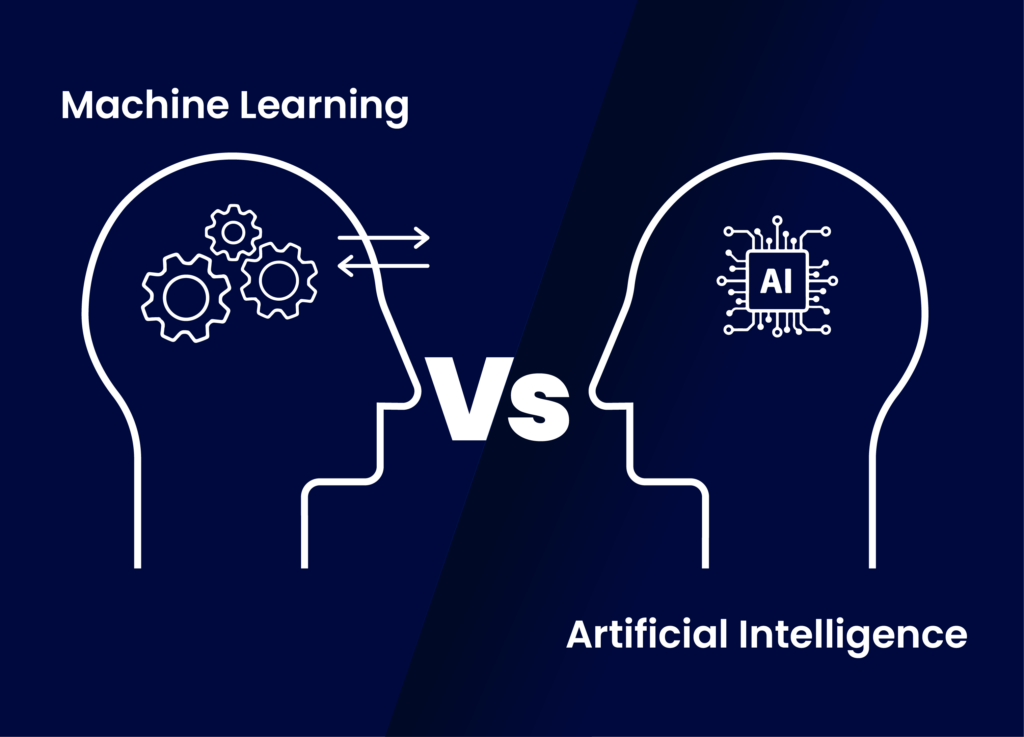
Artificial Intelligence and Machine Learning: What’s the Difference?
The use of artificial intelligence and machine learning is synonymous, but this does not imply that these concepts are similar. They are similar concepts in the computer science world, although they are different. The difference between the two is critical to learn among students, professionals, and business leaders to operate in the current technology-driven world.
The wider term of artificial intelligence is where machines can perform tasks that should have been handled by human intelligence. Machine learning, in its turn, is a subfield of AI that aims at allowing systems to learn and get progressively better.
This paper discusses their definitions, how they are different, their practical examples, and reasons why it is essential to know of both in contemporary digital world.
What Is Artificial Intelligence?
Artificial intelligence (AI) is a simulation of machine human intelligence. The AI systems are made to execute functions in reasoning, solving problems, decision-making, and understanding the language.
Artificial intelligence is geared towards developing systems that can replicate the cognitive processes such as learning and adaptation. Such systems may be run with a certain amount of autonomy.
Applications of AI are virtual helpers, recommendation engines, and self-driving cars. The concept of AI is to develop smart systems that are capable of thinking and acting.
What Is Machine Learning?
AI has a subcountry called machine learning that enables computers to learn without being programmed. Machine learning algorithms are not based on a rulebook and instead they process data, identify trends and make predictions. The larger the quantity of data that they work on the more efficient they are at a particular task.
As an example, a spam filter based on machine learning can identify emails that one does not want by studying old instances. Simply, one of the ways to accomplish artificial intelligence is through machine learning.
The Relationship Between Artificial Intelligence and Machine Learning
Since it is important to have a clear idea of what artificial intelligence and machine learning are, it is better to think of AI as an umbrella idea and ML as a tool of its utilization.
Robotics, expert systems, and natural language processing are some of the technologies that comprise AI. One of the strongest methods, which allows AI systems to work successfully, is machine learning.
Machine learning would not allow the modern AI applications to process large amounts of data in a more efficient manner.
Key Differences Between AI and ML
Artificial intelligence and machine learning are two similar concepts, which vary in terms of scope, purpose, and functionality.
1. Scope
AI is a wide field which aims at developing smart systems. ML is a particular branch of AI that is concerned with learning data.
2. Objective
AI will seek to create the machines that can reason in a way similar to humans. ML is focused on creating algorithms that do the right thing with experience.
3. Functionality
The AI systems can be based on the rule-based logic or advanced learning models. Machine learning systems are mainly based on data-driven training.
4. Complexity
AI may involve complicated decision-making models and reasoning. ML is usually concerned with predictive analysis and pattern recognition.
Types of Machine Learning
The knowledge of the machine learning types helps to explain their purpose in artificial intelligence and machine learning systems.
Supervised Learning
During supervised learning, models are trained by using labeled data. The algorithm is trained to find the mapping between inputs and known outputs.
Unsupervised Learning
Unsupervised learning analyzes unlabeled data to identify hidden patterns or clusters.
Reinforcement Learning
Reinforcement learning learns by trial and error. Actions are rewarded or penalized in systems to enhance performance over time.
These methods allow the ML systems to be adaptable and evolve.
Technologies Supporting AI and ML
Artificial intelligence and machine learning systems are run by several technologies.
Natural Language Processing
Natural language processing facilitates the interpretation and production of human language by machines. It is popular with chatbots, translators and voice recognition.
Deep Learning
Deep learning is a particular field of machine learning, which is based on the ability of a neural network to process more complicated data.
Facial recognition and speech processing are examples of the high-tech applications that are powered by deep learning.
Real-World Applications
Machine learning and artificial intelligence have an effect on many sectors.
Healthcare
Diagnostic systems that utilize AI are used to diagnose early-stage diseases by analyzing patient data and medical images. Models of machine learning make predictions of therapy.
Finance
Fraud detection and risk assessment is done with AI by financial institutions. ML algorithms are used to compute patterns of transactions to determine the suspicious activity.
Retail
Retailers use ML to make individualized recommendations and predict inventory. Intelligent chat systems make the customers experience better with the help of AI.
Transportation
Self-driving cars use artificial intelligence to drive and decide on the way in real-time.
How Businesses Use AI and ML
Such companies as Google and Microsoft allocate their funds to the development of AI and ML. These technologies are incorporated in customer service, marketing analytics, and supply chain management in businesses.
Artificial intelligence can be used in conjunction with machine learning to enhance efficiency within organizations, lower costs, and create competitive advantages.
Benefits of Artificial Intelligence and Machine Learning
Many advantages are linked to AI and ML usage in organizations:
- Better decisions with the help of data.
- Repetitive tasks are automated.
- Increased customer differentiation.
- Growth in efficiency of operations.
- Solutions to meet increased demands.
These merits lead to innovation and sustainable development.
Challenges and Ethical Considerations
Artificial intelligence and machine learning promise great possibilities, but they bring problems. There is data privacy that is a major concern. Systems are based on massive databases, and they need to be treated with responsibility.
There is also the issue of algorithmic bias. Predictions can be unjust or inaccurate in case there is some bias in training data. To resolve these issues, organizations have to initiate clear and ethical AI systems.
The Future of AI and ML
Artificial intelligence and machine learning have a bright future. The innovations are going on in advancements in computing and availability of data.
Other emerging trends are generative AI, edge computing, and real-time analytics. The developments will increase AI capabilities in industries. With the advent of technology, the knowledge on the difference between AI and ML will continue to be vital to both professionals and businesses.
Conclusion
Machine learning and artificial intelligence represent different ideas, though they are linked to each other. AI is the more general aim of making intelligent machines, whereas ML is a particular technique that allows the systems to learn from data.
Individuals and organizations will be in a better position to utilize their potential by understanding their differences and applications. Since healthcare and finance are examples of industries that have been revolutionized by AI and ML, there is no doubt that AI and ML have reshaped industries across the globe.
The awareness of artificial intelligence and machine learning in the digital era is not only advantageous but it is a necessity to remain competitive and innovative. Join the Cyprus AI Expo to meet AI leaders from around the world. Visit Cyprus AI Expo to secure your place today. https://www.cyprusaiexpo.com/